
Immune system research
8 January 2026
Diversity of mononuclear phagocyte populations in the healthy and inflamed human intestine
Inflammatory bowel disease:
Researchers from the LEO Foundation Skin Immunology Research Center (SIC) at the University of Copenhagen have made new insights into the composition of antigen presenting cells in the intestines of people suffering from inflammatory bowel disease (IBD).
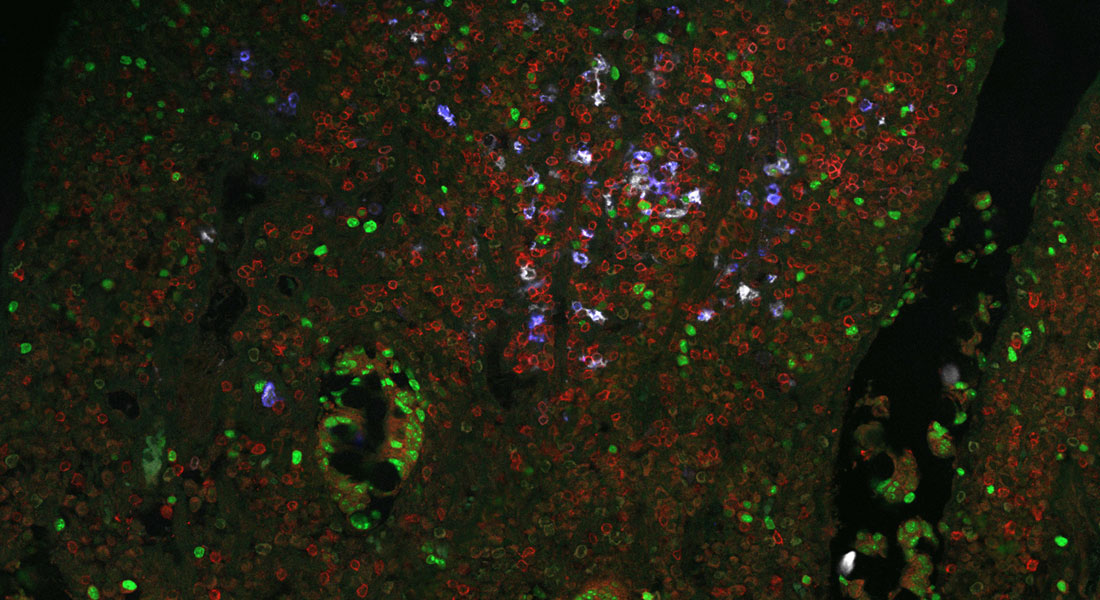
The researchers’ study focusses on mononuclear phagocytes (MNPs), which are key components of our immune system that are essential to maintaining host homeostasis but can also promote tissue pathology in the setting of chronic inflammatory diseases.
MNP consist of monocytes, macrophages and conventional dendritic cells (cDCs), each playing distinct roles in host homeostasis. While macrophages fight infections locally and mediate tissue homeostasis and repair, cDCs are essential for the initiation and regulation of adaptive immune responses.
‘Despite their importance to our health, a full understanding of MNP diversity and function in the human intestine and how this is altered during chronic intestinal disease is lacking’, said Venla Väänänen, one of the shared first authors on this manuscript. ‘We used unique tissue processing techniques in combination with single-cell RNA sequencing, flow cytometry and imaging to fully map MNP diversity in the healthy human intestine in patients with IBD.’
Key findings from this study include the demonstration that (1) the healthy human intestine contains a diverse array of mature macrophage and cDC populations, whose proportions differ between the ileum and colon, (2) that the human intestine contains putative macrophage and cDC subset specific precursors and (3) that LAMP3+CCR7+ activated dendritic cells accumulate in the mucosa of IBD patients and are closely associated with proliferating T cells.
The study provides an important atlas of intestinal MNP diversity and function in health and disease and a roadmap for further studies focusing on the identification of MNP centric pathways for the treatment of IBD.
Read the full study: https://doi.org/10.1126/sciimmunol.adz8650
Contact
Venla Anniina Väänänen, PhD Fellow
Skin Immunology Research Center
E-mail: venlan@sund.ku.dk
William Winston Agace, Professor
Skin Immunology Research Center
E-mail: williamagace@sund.ku.dk
Telephone: +45 35 32 50 99