
Antibody-drug conjugates offer a strategy for targeted elimination of Cutaneous T cell cancers
Researchers from the LEO Foundation Skin Immunology Research Center (SIC) and collaborators have developed a new antibody-drug conjugate strategy designed to selectively eliminate malignant T cells in T cell cancers.
Patients with T cell cancers – leukaemia and lymphoma – like Cutaneous T cell lymphoma are very hard to treat as cancer cells evolve to overcome therapy and become resistant to drugs. Patients also get infections which can be fatal. Therefore, novel treatments that target cancer cells including subclones while sparing healthy cells are necessary.
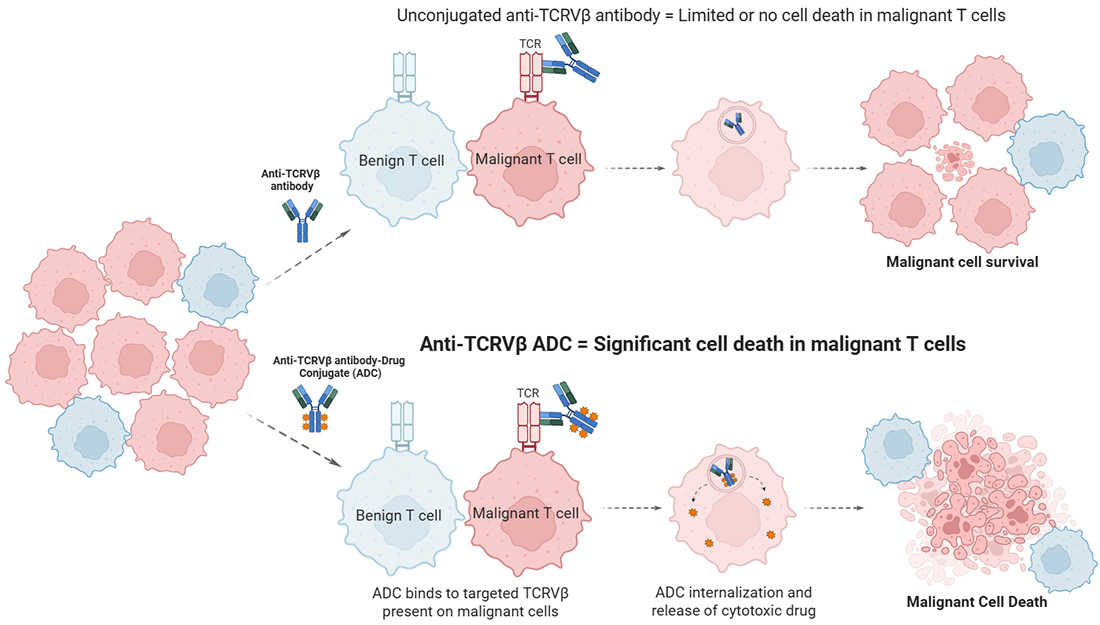
To address this, researchers from SIC in collaboration with BRIC present a strategy that uses antibody-drug conjugates, or ADCs, to target a defining feature of malignant T cells: their T cell receptor beta-chain variable region, known as TCRVβ.
Malignant T cells often arise from a single cancerous T cell clone. This means that the cancer cells may share the same TCRVβ identity, while 90-99% of healthy T cells carry other TCRVβ variants. The researchers used this biological feature to design ADCs that can recognize and bind selected TCRVβ targets on malignant T cells. After binding, the ADC is taken up by the cell and releases a toxic payload inside, leading to the death of the targeted malignant T cell.
“This strategy turns the malignant T cell’s own identity against it,” says lead and co-corresponding author, Chella Krishna Vadivel. “By targeting TCRVβ, we can guide a potent drug directly to the cancer cells.”
Our results give hope that TCRVβ-targeted ADCs could become a more selective treatment concept for patients with T cell cancers.
The study is still at an early research stage, and further studies will be needed before the strategy can be tested clinically. However, the work points to a new way of thinking about targeted therapy in T cell cancers: rather than targeting all T cells, future treatments may be tailored to the specific TCRVβ signature of the malignant clone.
The full study is published in Blood Advances
Contact
Chella Krishna Vadivel cvadivel@sund.ku.dk
Niels Ødum ndum@sund.ku.dk